Saturday, April 19, 2014

A couple from Ohio leave us a great legacy of love


This is one of those stories that touches your heart.  It is the story of Kenneth & Helen Felumlee:

"They held hands at breakfast, even after 70 years of marriage.

And when Helen Felumlee left this life at the age of 92, her beloved husband followed in her footsteps less than a day later.

“We knew that when one went, the other was going to go,” daughter Linda Cody told the Zanesville Times Recorder in Ohio. “We wanted them to go together, and they did.”

The couple, married as teenagers, were always inseparable, their children said."

They married in early 1944 and passed away a few days ago.

A very neat story.


Tags: Ohio couple married 70 years  To share or post to your site, click on "Post Link". Please mention / link to the My View by Silvio Canto, Jr. Thanks!

Someone in Maduro's government must be held responsible for the deaths

(My new American Thinker)

There are talks underway in Venezuela, as reported by The Washington Post:
"Venezuelan opposition leaders began a late-night meeting with President Nicolás Maduro and his cabinet Thursday in a possible first step toward ending two months of anti-government protests and street clashes that have left at least 41 dead.   The meeting was broadcast live on Venezuelan television and radio, at the insistence of the opposition, and was attended by mediators from Brazil, Ecuador, Colombia and the Vatican. The representative of the Holy See in Venezuela, Aldo Giordano, opened the meeting by reading a written statement from Pope Francis urging both sides to put aside differences and summon the courage to reach an agreement.  Maduro followed, speaking for more than half an hour, and insisted that the encounter was a “dialogue,” not a negotiation. “I’m willing to debate all of the country’s problems,” he said. “But we need to join together in condemning violence as a way to force political change.”  With 11 members of the opposition and 11 members from the government side scheduled to speak, it appeared likely that the meeting would stretch well past midnight. Both sides indicated that future meetings would be required to work out the biggest sticking points between the two sides, especially the fate of jailed protesters. Henrique Capriles, the opposition standard-bearer who narrowly lost to Maduro in last April’s president election, was the most prominent figure on the anti-­government side. While the encounter allowed opposition leaders an unusually open platform to speak directly to a national audience and the president himself, it was also notable for the absence of the opposition’s more hard-line anti-Maduro wing.  That’s the branch that has been in the streets battling national guardsmen and blocking traffic with flaming barricades, and it may be unwilling to heed any agreements that emerge from the talks with Maduro.  María Corina Machado, the congresswoman who has emerged as the most prominent opposition voice in recent weeks after the arrest of fellow anti-Maduro hard-liner Leopoldo ­López, boycotted the event, saying no meeting with the president should be occurring while protesters and opposition leaders remain in jail."
I'm OK with a dialogue but the opposition should demand several things:

1) Who will be held responsible for the deaths?  43 people are dead and that is unacceptable.  Who gave the order to shoot people peacefully protesting?

2) When will the government allow a free press and media?  It's a shame that the world has learned about the atrocities from the people on the streets using social media.  Venezuela must restore the vibrant media that it had years ago.

There are probably other issues but those are my two starting points. 

The Maduro administration has lots of blood in its hands and it's time to demand explanations.

P. S. You can hear my chat with Mr Cazorla in Venezuela here & follow me on Twitter @ scantojr.


Popular Politics Internet Radio with Silvio Canto Jr on BlogTalkRadio


Tags: Venezuela  To share or post to your site, click on "Post Link". Please mention / link to the My View by Silvio Canto, Jr. Thanks!

RIP: A word about Cheo Feliciano


We just heard that Cheo Feliciano was killed in a traffic accident in Puerto Rico:

"During the 1970s he became a major star of salsa (the name was used by American marketers as a catchall for various Latin rhythms) when he recorded for the New York label Fania. His first solo album, “Cheo,” included songs that became his signatures: “Anacaona” and “Mi Triste Problema.”     

“He was an icon, beloved by the females,” Joe Conzo Sr., a music historian and a longtime friend of Mr. Feliciano, said in an interview on Thursday. “His boleros, they had the women swooning.”"

My introduction to Cheo was the legendary "Quitate tu" by The Fania All Stars.  It was recorded in 1971 and introduced millions to "salsa" or Latin music.

Feliciano went on to a great solo career.  His contributions rank him as one of the all time greats:


Tags: Cheo Feliciano  To share or post to your site, click on "Post Link". Please mention / link to the My View by Silvio Canto, Jr. Thanks!

Thursday, April 17, 2014

Oppenheimer cautious about Latin America

(My new American Thinker post)

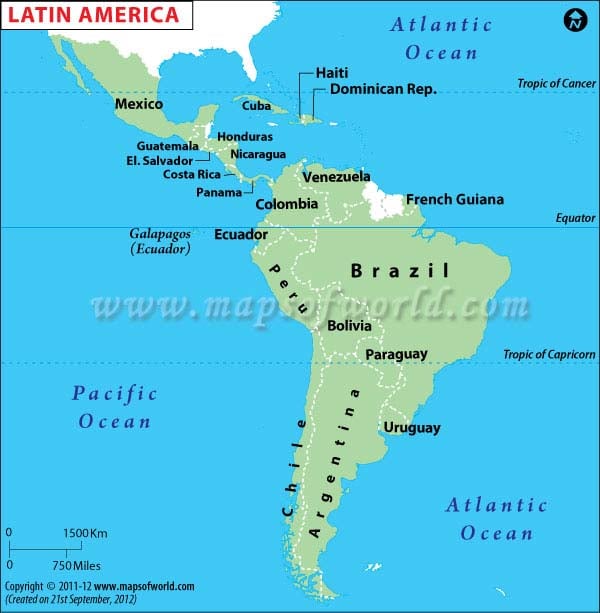
Latin America is a region of contrasts, as any tourist or frequent traveler will tell you.

The "Cuba-Venezuela" group is a mess.  The economies are not growing and a disregard for "the rule of law" discourages investment.

The Chile-Mexico-Colombia group is doing a lot better, in large part because of their political stability and attractive treatment of investors.  For example, Mexico just passed energy reforms and Chile continues to be the envy of the region. 

Colombia and the US are trading more than ever, in large part because of the free trade agreement.

Overall, I agree with Andres Oppenheimer that "caution" may be in order:
"According to the IMF's semi-annual report released at its spring meeting in Washington on April 8, Latin America's economy will grow by 2.5 percent this year, and by 3 percent next year.
That's lower than the region's growth rates in the past decade, but suggests that its economies may soon begin to rebound. 
The World Bank, in its “consensus forecast” based on nearly three dozen projections by mostly private sector banks, said that Latin America's economy will grow by 2.3 percent this year, and by 3 percent in 2015.
In January, the World Bank had forecast an “upbeat” future for the region, forecasting a 3.7 percent growth rate in 2016.  
Among the region's largest economies, the best-performing one will be Mexico, which is scheduled to grow by 3 percent this year, and by 3.5 percent next year, the IMF said.
“Mexico’s ongoing economic reforms, especially in the energy and telecommunications sectors, herald higher potential growth for the medium term,” the IMF said in its report. 
Other countries that will show healthy growth rates will be Peru, (projected to grow by 5.5 percent this year and 5.8 percent next year,) Bolivia (5.1 percent this year and 5 percent next year,) Paraguay (4.8 percent this year and 4.5 percent next year), Colombia (4.5 percent both years) and Chile (3.6 percent this year and 4.1 percent next year,) the IMF said. 
Among the countries that will show meager growth are Brazil, the region's largest country, which is projected to grow by 1.8 percent this year and 2.7 percent next year, according to the IMF.
Brazil's economy will continue to suffer from a “loss of competitiveness and low business confidence,” the IMF said. 
Finally, Latin America's worst performing economies will be Venezuela and Argentina, the IMF says.
Venezuela's economy will shrink by 0.5 percent this year, and will drop by another 1 percent next year.  
In an interview, IMF Western Hemisphere director Alejandro Werner told me that he projects Venezuela's inflation rate, which reached a world record of 56 percent last year, to rise to 75 percent in 2014.
Werner said that unless Venezuela adopts an economic adjustment program, inflation may turn into hyper-inflation in coming years.
“Typically, when countries reach inflation rates of 50 or 55 percent, they either adopt adjustment programs to put a break on it, or inflation keeps growing progressively,” he said. 
Argentina's economy is projected to remain virtually flat, with a 0.5 percent growth this year, and will probably grow by 1 percent next year."
Again, Latin America is showing the world that "free markets and the rule of law" works.  

At the same time, the economies that lack freedom (like Cuba or Venezuela) or have a huge tax burden or big government (like Brazil) do not grow.

P. S. You can hear our US-Latin America show of the week with Fausta Wertz and Cecilia Torres here & follow me on Twitter @ scantojr.


Listen To Politics Internet Radio Stations with Silvio Canto Jr on BlogTalkRadio


Tags: Latin America  To share or post to your site, click on "Post Link". Please mention / link to the My View by Silvio Canto, Jr. Thanks!
Wednesday, April 16, 2014

Cubans remember something else that happened on April 15th

(My new American Thinker post)

Like you, April 15th is "IRS day" or the day that you rush to the post office to get that tax return in the mail.  More recently, it's the day that we file online.  Or, maybe the day that we renew our call for a "flat tax".

In baseball terms, April 15th is the day that Jackie Robinson broke what they used to call "the color line" in the major leagues.  He opened the game at first base and made history.  

For Cubans, and especially those of my parents' generation, April 15th is the day that Fidel Castro visited the US in 1959, a few months after taking power.

Castro's visit was rather controversial because he faced skepticism from many in the US.  He was asked about the promised elections that were delayed and delayed.  He also heard over and over about communists in the background:
"The trip got off to an inauspicious start when it became clear that President Dwight D. Eisenhower had no intention of meeting with Castro. Instead, Eisenhower went to the golf course to avoid any chance meeting with Castro.
Castro gave a talk to the Council on Foreign Affairs, a New York-based group of private citizens and former government officials interested in U.S. international relations.
Castro was confrontational during the session, indicating that Cuba would not beg the United States for economic assistance.
Angered by some of the questions from the audience, Castro abruptly left the meeting.
Finally, before departing for Cuba, Castro met with Vice President Richard Nixon.
Privately, Nixon hoped that his talk would push Castro "in the right direction," and away from any radical policies, but he came away from his discussion full of doubt about the possibility of reorienting Castro's thinking.
Nixon concluded that Castro was "either incredibly naive about communism or under communist discipline-my guess is the former.""
Castro also appeared on Meet the Press and denied that he was a communist.  He even joked about it saying that some people think that Adam & Eve were communists. 

The video is classic:


Castro denied that he was a communist and put people in jail for accusing him of that.  In December 1961, he declared his allegiance to Marxism-Leninism!    None of the people jailed for suggesting communism were released when Castro confirmed that he was a communist.

I think about my parents, my dad's cousin held as a political prisoner and other things about Cuba that happened that April 15th!

P. S. You can hear CANTO TALK here & follow me on Twitter @ scantojr.


Check Out Politics Podcasts at Blog Talk Radio with Silvio Canto Jr on BlogTalkRadio


Tags: Cuba and Castro  To share or post to your site, click on "Post Link". Please mention / link to the My View by Silvio Canto, Jr. Thanks!

Brazil on the eve of The World Cup 2014


We spoke about the situation in Brazil with Monica Showalter of IBD plus Michael Prada.  

The World Cup has forced Brazil to look at corruption, infrastructure problems and the protests.


Tags: Brazil  To share or post to your site, click on "Post Link". Please mention / link to the My View by Silvio Canto, Jr. Thanks!

Tuesday, April 15, 2014

"Race card" Holder is a disgrace


My guess is that serious Democrats have to be horrified with AG Holder's comments about being treated "different."   

We are watching an Attorney General who has no respect for the office he holds. He is acting like a partisan street politician rather than the top law enforcement officer in the US!

I agree with how John Fund and Hans von Spakovsky describe AG Holder's tenure:
"A veteran Justice Department lawyer says that Attorney General Eric Holder has politicized the department in a way he hadn’t seen before. In short, “Holder is the worst person to hold the position of attorney general since the disgraced John Mitchell.”
Now in his sixth year as attorney general, Holder has increasingly tilted the department in an ideological direction. It’s one thing to emphasize President Obama’s legal priorities. It’s quite another to decide not to enforce certain federal laws — such as the ban on marijuana — or urge state attorney generals to refuse to defend local laws on same-sex marriage. Legal changes are achieved through legislation, not through a sudden whim not to enforce them. No other attorney general has acted in this manner."
And no other Attorney General has ever accused his critics of "racism".

Remember Janet Reno?  Remember how she got treated after Waco '93?  Do you recall AG Reno saying that she was being treated differently because she is a woman?  On the contrary, she took responsibility for Waco and answered questions.

How about Alberto Gonzalez, the first Hispanic AG.  Did he "whine" about being treated differently?

From "Fast & Furious" to the "IRS," AG Holder has shown a preference for his side rather than the rule of law.  He targeted Arizona but looked the other way when California & Illinois issued driver's license to people in the US without papers.

On top of that, he has accused Texas and other states of "racism" because we want to protect the integrity of the election laws.

My father once told me that you can survive corrupt politicians but not a police chief.  In other words, those entrusted to enforce the law can not be corrupt or the whole system collapses.

Frankly, President Obama could do the country, and especially his administration, a big favor by telling AG Holder to spend more time with his family and leave public service.

P. S. You can hear my chat with Jim Yardley, contributor to American Thinker,  about AG Holder & follow me on Twitter @ scantojr.


Discover Politics Internet Radio with Silvio Canto Jr on BlogTalkRadio


Tags: AG Holder and the "race card"  To share or post to your site, click on "Post Link". Please mention / link to the My View by Silvio Canto, Jr. Thanks!

"Medical tourism" with Carlos Roncal, CEO, World Language Schools


We spoke with Carlos Roncal, CEO of World Language School in Dallas, TX.  We spoke about "medical tourism",  a business of the future.


Tags: Medical tourism  To share or post to your site, click on "Post Link". Please mention / link to the My View by Silvio Canto, Jr. Thanks!

Pre-Castro Cuba had problems but “a worthless peso” was not one of them!

(My new Babalu post)


My father has a copy of a pre-Castro Cuban peso framed in his home office.  I see it every Sunday when we visit my parents and enjoy some of my mom's Cuban food.
It's been on that wall for a long time, together with that quote from Jose Marti:
“Nunca son más bellas las playas del destierro que cuando se les dice adiós." (Thanks to my friend Jorge Ponce for writing about this)
The Cuban peso and the Marti quote have always reminded us of Cuba.
They bring back  Cuba and the stories that we would hear daily at the dinner table growing up in Wisconsin.
My parents were completely committed to the proposition that we'd always remember Cuba.  I am very happy that they were!
The following story about life in the island brought my father's Cuban peso back to life. .
We just learned today that Cubans have something else to worry about:
"Cubans are taking another hit to their wallets as the government announces an increase in the cost of powdered milk, a staple of every home with children and basic to the diet of nearly everyone on the island.The measure will not affect the state-subsidized supply of powdered milk to children aged seven and under.They receive three kilograms of powdered milk at the equivalent of 40 U.S. cents a kilogram, paid for in ordinary Cuban pesos.But at hard-currency stores, the price of a half-kilogram package will go up 45 cents from $2.90 to $3.35. A kilogram package will go up by 85 cents or from $5.75 to $6.60.These stores sell in Cuban convertible pesos (CUC) comparable to the U.S. dollar and already have a 240 percent markup on their products.The average state employee earns the equivalent of between $20 to $30 USD a month and spends up to 80 percent of their income just on food so any price hike puts the family budget into a tailspin."Everything is difficult and this price rise will make them more difficult," said Magdalena, a 45-year-old woman who has a 15-year-old daughter and a 19-year-old son."If prices go up in the shops, the price on the black market will also increase so we won't be able to buy as much.""
Another day and another failure "para la revolucion"!
By the way, pre-Castro had its problems and we've been very frank about them. The island had its share of political problems and corruption was a factor.  My parents were there in the 1950's and they are the first ones to recognize the island's shortcomings.
At the same time, "milk problems" caused by a weak and worhtless currency was not one of them.
There was lots of "leche cubana" (Cuban milk) to go around and a strong Cuban peso to handle any imports if bad weather or some other reason, made that necessary.
Imported milk, or price fluctuations of such imports, was not something that our mothers or "abuelas" (grandmothers) had to worry about.  They had plenty of milk brands to choose from when they went to "la bodega".
The island produced enough milk and had sound money, as we see here and many other studies.
Again, another failure for "la revolucion" and more pain for the ones in the island!
And another reminder of how bad "esta revolucion" has been for Cuba and Cubans!

Tags: Pre-Castro Cuba  To share or post to your site, click on "Post Link". Please mention / link to the My View by Silvio Canto, Jr. Thanks!

Monday, April 14, 2014

How do you say 'it's the economy, stupid,' in Spanish?

(My new American Thinker post)


This is one of those stories that you do not want to believe. 

After all, how can President Pena-Nieto of Mexico be slumping in polls?  Isn't this the man who's just pulled off some rather amazing reforms?  Haven't pundits and columnists praised this man for his ability to tackle problems, specially the "sacred cows" of modern Mexico?

Yes, President Pena-Nieto is down in the polls, as reported by The Washington Post:
"Plenty of world leaders would be thrilled to have the kind of executive hot streak blazed by Mexico’s Enrique Peña Nieto during his first 16 months in office. 
In that short span, he and his administration have steered more than a dozen major new laws through congress, overhauling the country’s energy, banking and education sectors, among others.  
Peña Nieto has stood up to powerful interests from Mexico’s business world and underworld. He has locked up drug lord Joaquin “El Chapo” Guzmán, the world’s most-wanted trafficker, quieting doubters in the United States who questioned his crime-fighting mettle. 
Yet for all the praise he has won in Washington and elsewhere in the world, Peña Nieto’s opening act is getting panned in the only place it really counts: Mexico. 
After Time magazine put him on the cover of its international edition recently with the caption “Saving Mexico,” a flood of ridicule and derision followed. 
Peña Nieto’s approval ratings have fallen fairly steadily since he took office in December 2012, dropping to 37 percent in one recent poll, with other surveys rating him in the mid-40s.  
The biggest problem, analysts say, has been Mexico’s feeble growth. Last year the country’s economy expanded at just 1.1 percent, far below the goal of 5 percent growth Peña Nieto set when he ran for president. 
His most widely touted move, a constitutional amendment opening Mexico’s state-controlled energy sector to private and foreign investment, was advertised as a catalyst for faster growth, but it may take years for the benefits to materialize.  
According to Mexican economist Luis de la Calle, a bold legislative agenda doesn’t tend to favor short-term success.""
The good news is that President Pena-Nieto has a 6-year term and he will be around until December 1, 2018. 

In other words, he has time to turn this around and prove to Mexican voters that the changes will eventually be good for the country.

The bad news is that it's all about the economy for the modern voter, especially when the economy does not grow as promised.

P. S. You can hear CANTO TALK here & follow me on Twitter @ scantojr.


More Politics Podcasts at Blog Talk Radio with Silvio Canto Jr on BlogTalkRadio


Tags: Mexico  To share or post to your site, click on "Post Link". Please mention / link to the My View by Silvio Canto, Jr. Thanks!